



Special offer valid until 31 December 2010 (subject to availability) – delivery time: two weeks.
A great success of the estate, an elegant wine, of incredible freshness, and of remarkable aromatic purity.
“A wine of a brilliant gold, with bewitching roasted aromas and a full-bodied, full-bodied, very long mouthfeel. One
Delicious wine today (with foie gras, a Roquefort or, as an aperitif) that will age perfectly.”
Thierry Desseauve, editor-in-chief of the Revue du Vin de France
The 1991 vintage as seen by Mireille Daret:
The 1991 vintage was marked by a climatological accident: the frost of 21 April. While the vines had already grown, this frost destroyed all hopes of an abundant harvest. During the months of July and August, temperatures are above seasonal norms. Severe thunderstorms in August further reduced the harvest. But the ripeness is good at the end of September, when temperatures are well above seasonal norms. The first “sorting” of the harvest began around 20 September and continued until November.
All in all, the heat of July, August and September made it possible to harvest a great 1991 vintage, well concentrated, with a lot of substance, very qualitative… unfortunately in very small quantities. At Cru Barrejats, for a cultivated area of 2 hectares in 1991, we produced 2400 bottles, i.e. a yield of 9 hectolitres per hectare (compared to 25 hectolitres usually authorised in the Sauternes appellation).
Aware that we could not “spoil” the slightest grape, we “sorted” the “botrytised” grapes during the harvest in a very meticulous way, really one by one. To do this, 20 pickers worked, a total of a dozen days, between the end of September and the end of November 1991. This is how we were able to achieve a completely homogeneous and splendid 1991 harvest quality! We all know in the Sauternes region that, when the terroir and the grapes are of high quality, the greatness of the vintages is obtained by the work of Man during the harvest: the “Sauternes sort”…
The grapes, without having been crushed, are then pressed in an old vertical hydraulic press (made of wood and stainless steel). Three slow presses of up to 200 bars, interspersed with manual “re-cutting”, make it possible to obtain concentrated musts, low in sludge, free of any vegetal taste. The pressing lasts about 7 hours, and makes it possible to obtain a maximum of one barrel of juice, i.e. 2.25 hectoliters, the equivalent of 300 bottles. In 1991, each day of the harvest gave us between 0.5 and 1 hectolitre!
We practice cold “settling” before fermentation in new stave oak barrels, with very tight grains, medium toast, and fine staves allowing the best oxidative exchanges through the wood. The coopers chosen for the 1991 vintage are Taransaud and Mercier. Fermentation in barrels takes place slowly, in very optimal conditions at 16°C, because we control the temperature of the fermentation cellar. Two rackings, then fining, are carried out during the ageing in barrels, which lasted 18 months for the 1991 vintage. Filtration precedes bottling.
CRU BARREJATS 1991
| Région | Bordeaux |
|---|---|
| Designation | Sauternes |
| Color | sweet |
| Vintage | 1991 |
| Label | AUCUN |
| Capacity | 75cl |


CRU BARREJATS
Special offer valid until 31 December 2010 (subject to availability) - delivery time: two weeks.
A great success of the estate, an elegant wine, of incredible freshness, and of remarkable aromatic purity.
"A wine of a brilliant gold, with bewitching roasted aromas and a full-bodied, full-bodied, very long mouthfeel. One
Delicious wine today (with foie gras, a Roquefort or, as an aperitif) that will age perfectly."
Thierry Desseauve, editor-in-chief of the Revue du Vin de France
The 1991 vintage as seen by Mireille Daret:
The 1991 vintage was marked by a climatological accident: the frost of 21 April. While the vines had already grown, this frost destroyed all hopes of an abundant harvest. During the months of July and August, temperatures are above seasonal norms. Severe thunderstorms in August further reduced the harvest. But the ripeness is good at the end of September, when temperatures are well above seasonal norms. The first "sorting" of the harvest began around 20 September and continued until November.
All in all, the heat of July, August and September made it possible to harvest a great 1991 vintage, well concentrated, with a lot of substance, very qualitative... unfortunately in very small quantities. At Cru Barrejats, for a cultivated area of 2 hectares in 1991, we produced 2400 bottles, i.e. a yield of 9 hectolitres per hectare (compared to 25 hectolitres usually authorised in the Sauternes appellation).
Aware that we could not "spoil" the slightest grape, we "sorted" the "botrytised" grapes during the harvest in a very meticulous way, really one by one. To do this, 20 pickers worked, a total of a dozen days, between the end of September and the end of November 1991. This is how we were able to achieve a completely homogeneous and splendid 1991 harvest quality! We all know in the Sauternes region that, when the terroir and the grapes are of high quality, the greatness of the vintages is obtained by the work of Man during the harvest: the "Sauternes sort"...
The grapes, without having been crushed, are then pressed in an old vertical hydraulic press (made of wood and stainless steel). Three slow presses of up to 200 bars, interspersed with manual "re-cutting", make it possible to obtain concentrated musts, low in sludge, free of any vegetal taste. The pressing lasts about 7 hours, and makes it possible to obtain a maximum of one barrel of juice, i.e. 2.25 hectoliters, the equivalent of 300 bottles. In 1991, each day of the harvest gave us between 0.5 and 1 hectolitre!
We practice cold "settling" before fermentation in new stave oak barrels, with very tight grains, medium toast, and fine staves allowing the best oxidative exchanges through the wood. The coopers chosen for the 1991 vintage are Taransaud and Mercier. Fermentation in barrels takes place slowly, in very optimal conditions at 16°C, because we control the temperature of the fermentation cellar. Two rackings, then fining, are carried out during the ageing in barrels, which lasted 18 months for the 1991 vintage. Filtration precedes bottling.
Learn more >
A great success of the estate, an elegant wine, of incredible freshness, and of remarkable aromatic purity.
"A wine of a brilliant gold, with bewitching roasted aromas and a full-bodied, full-bodied, very long mouthfeel. One
Delicious wine today (with foie gras, a Roquefort or, as an aperitif) that will age perfectly."
Thierry Desseauve, editor-in-chief of the Revue du Vin de France
The 1991 vintage as seen by Mireille Daret:
The 1991 vintage was marked by a climatological accident: the frost of 21 April. While the vines had already grown, this frost destroyed all hopes of an abundant harvest. During the months of July and August, temperatures are above seasonal norms. Severe thunderstorms in August further reduced the harvest. But the ripeness is good at the end of September, when temperatures are well above seasonal norms. The first "sorting" of the harvest began around 20 September and continued until November.
All in all, the heat of July, August and September made it possible to harvest a great 1991 vintage, well concentrated, with a lot of substance, very qualitative... unfortunately in very small quantities. At Cru Barrejats, for a cultivated area of 2 hectares in 1991, we produced 2400 bottles, i.e. a yield of 9 hectolitres per hectare (compared to 25 hectolitres usually authorised in the Sauternes appellation).
Aware that we could not "spoil" the slightest grape, we "sorted" the "botrytised" grapes during the harvest in a very meticulous way, really one by one. To do this, 20 pickers worked, a total of a dozen days, between the end of September and the end of November 1991. This is how we were able to achieve a completely homogeneous and splendid 1991 harvest quality! We all know in the Sauternes region that, when the terroir and the grapes are of high quality, the greatness of the vintages is obtained by the work of Man during the harvest: the "Sauternes sort"...
The grapes, without having been crushed, are then pressed in an old vertical hydraulic press (made of wood and stainless steel). Three slow presses of up to 200 bars, interspersed with manual "re-cutting", make it possible to obtain concentrated musts, low in sludge, free of any vegetal taste. The pressing lasts about 7 hours, and makes it possible to obtain a maximum of one barrel of juice, i.e. 2.25 hectoliters, the equivalent of 300 bottles. In 1991, each day of the harvest gave us between 0.5 and 1 hectolitre!
We practice cold "settling" before fermentation in new stave oak barrels, with very tight grains, medium toast, and fine staves allowing the best oxidative exchanges through the wood. The coopers chosen for the 1991 vintage are Taransaud and Mercier. Fermentation in barrels takes place slowly, in very optimal conditions at 16°C, because we control the temperature of the fermentation cellar. Two rackings, then fining, are carried out during the ageing in barrels, which lasted 18 months for the 1991 vintage. Filtration precedes bottling.
Other products in the domain CRU BARREJATS
-
More
info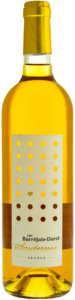
CRU BARREJATS-DARET 2011 75cl
CRU BARREJATSSauternes45,00 € + -
More
info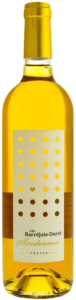
CRU BARREJATS-DARET 2010 75cl
CRU BARREJATSSauternes45,00 € + -
More
info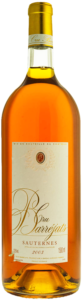
CRU BARREJATS EN MAGNUM 2003 150cl
CRU BARREJATSSauternes120,00 € + -
More
info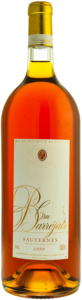
CRU BARREJATS EN MAGNUM 1999 150cl
CRU BARREJATSSauternes105,00 € + -
More
info
CRU BARREJATS 1998 75cl
CRU BARREJATSSauternes50,00 € + -
More
info
CRU BARREJATS 2002 75cl
CRU BARREJATSSauternes50,00 € +